
By Cristina De Fabritiis, Youth Ambassador for Toronto; Amber Louise Culley, Youth Representative for Ontario; Emily Dell, Youth Representative for Ontario; and Djenabou Diallo, Youth Ambassador for Gatineau
An indicator of the vibrancy of the youth movement within Development and Peace ― Caritas Canada is the wide range of activities that our young members participate in or lead across Canada. This series presents just two examples from this past summer. The first part was an account of an event in Moncton, N.B. In this second part, four participants reflect on their experiences at Model Youth Justice, a youth retreat co-organized by KAIROS Canada and Camp Micah from August 7 to 9, 2026, at the Hidden Acres Mennonite Centre in New Hamburg, Ont.
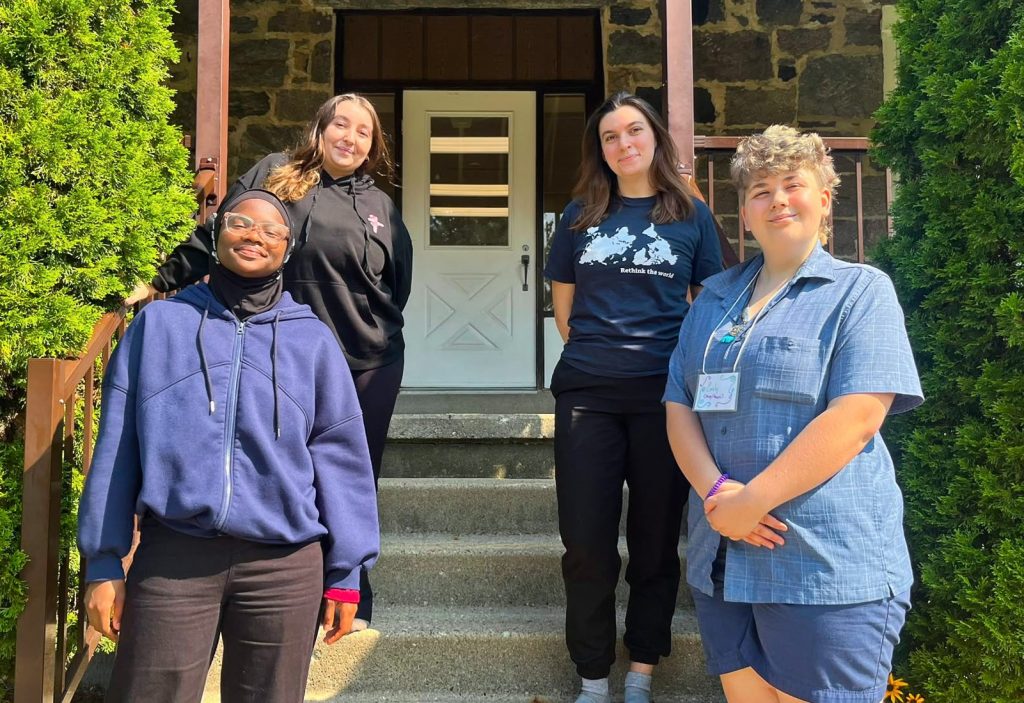
Youth justice is about me, you and us
Me. You. Us. Those were not words I began thinking of until I began looking at things differently at the Model Youth Justice camp, whose essence was about changing one’s perspective.
For three days, I was around a diverse range of youths from all walks of life. Participants and facilitators alike vulnerably shared their journeys, whether as refugees to Canada or as Indigenous leaders alchemizing trauma to inspire change in their communities.
Learning aspects of Indigenous―more specifically, Mohawk and Couchiching―heritage from the keynote speakers on the second day was especially engaging. Bangishimo and Amy Smoke, cofounders of the Willow River Community Land Trust started and ended their presentation with a drum circle. They drew in a Mohawk youth who was attending the camp. Witnessing traditions being thus beautifully reconnected and passed on to the youth was heartwarming.
I like to carry myself the mindset of learning something new every day. For me, it was especially enriching to learn about Mohawk culture and heritage. It has sparked my curiosity and added to my desire to work collectively for justice and for change.
― Cristina De Fabritiis
Youth justice: posing a crucial question

This was my second time at Model Youth Justice. I was introduced to it by KAIROS Canada representatives at the G7 Jubilee People’s Forum in Alberta last summer.
The retreat draws youths from a diversity of faith-related and other identities and experiences. It encourages participants to express their faith, background, identity, passions, interests and curiosities, and to discuss what peace and justice mean and how they can take part in the work required to being them about.
Teachings of youth empowerment; uplifting one another; navigating disagreement and dialogue; articulating concerns for justice; mobilizing; and building relationships were shared through campfires, song, dance, workshops, scenarios, teambuilding activities, conversations and time in nature. Being away from “regular life” made space for us to be comfortable, relax with one another, discuss various topics casually and feel less pressure to perform in a professional manner.
A facet of Model Youth Justice that I appreciated was that is did not have a fixed focus but allowed for many social justice topics to be discussed. We were all able to share what we were passionate about and learn from one another’s experiences of serving on youth councils, boards or committees; of daily life; of being newcomers or immigrants; of education and engagements; and more.
I learned that justice begins with people are coming together to discuss solutions. We immersed ourselves in workshops on dialogue, healthy communications, navigating difficult conversations, and turning disagreements or misunderstandings opportunities for connection and action towards justice.
On the last day, KAIROS Canada invited us to write down one goal that we would like to take part in and to stay in touch with one another. Then, we were left with a crucial question: “How will you go forward?”
― Amber Louise Culley
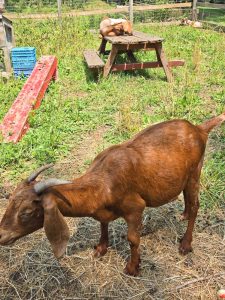
Youth justice amid willows and goats
Surrounded by the beauty of trees, wildlife and water, I forged new connections, made new friends, discovered social justice organizations and learned skills like building a fire, resolving conflicts and simply being present.
On the first night, after a session on land acknowledgements, we were given time to reflect on what they signify and what being sacred means. I visited a tree outside, where I wrote the following reflection:
I sit below the willow tree. To my left, lies the sage leaf that I placed against its root. Further, lies the gravel path leading away from the forest. To my right, beyond the tree, rest three of my relatives, the goats.
I hear the frogs, the cicada, children and teenagers talking and playing. I hear the hum of crickets.
When I look up, I see the branches and the leaves of the willow, casting down over me. This willow is my elder; its trunk is wider than myself…. I feel protected by it, drawn to it. My back rests along the grooves and bumps of its trunk; I am grounded in the soil around it. I wonder who else has sat in this spot. Who nurtured this willow to become what it is now?
Beyond the willow, in the sky, I see the stars that have been here for much longer than the willow…. I wonder how long it will be before we will have to protect them, as we do Mother Earth, from those who wish to exploit them.
A moth, once a caterpillar, circles me and the willow. Her day has just begun. I wonder how the lights we campers produce affect her.
The willow is sacred. But who has the privilege of deciding what is sacred? Those with power often hold only themselves to a standard of sacredness.
To hold something sacred, to reclaim power, I must acknowledge and reconcile my privilege as a human relative, a white settler, and hold something higher than myself. To fight for the right of sacredness, the right of ceremony, means I must rethink my thoughts.
I will hold you sacred, Willow, with your wisdom and your truth.
The next morning, we were visited by Bangishimo; Amy Smoke; their child, Sky; and a Mohawk Elder. They spoke about their land-back activism and their community work. Their accomplishments and Sky’s passion as a youth in the movement were truly inspiring.
Model Youth Justice reminded me what it is that I fight for every day and helped me feel motivated to continue my efforts toward justice. Thank you to the organizers and to Development and Peace ― Caritas Canada for making me aware of this opportunity and for funding my journey.
― Emily Dell
Youth justice: a message of hope
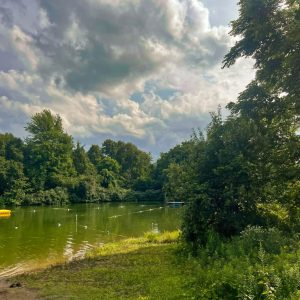
This was a real first for me: my first camp and, above all, my first interfaith event. Being out in nature and connecting with young people from such different backgrounds made me realize how small we are and how much there still is to learn. Each of us carries a lived experience that shapes how we see the world, how we see humanity, and how we define justice itself.
These two days marked, for me, the beginning of a deeper questioning. At a time when international solidarity can feel like a mirage and humanity seems increasingly under threat, it was heartening to see that the young people present, though they did not hold all the answers, were equipped with tools to move forward. Through games, simulations and moments of sharing, we saw how sensitive subjects can be approached in a lively, accessible way rather than through rigid theory.
The message of this camp is, above all, one of hope. When so much in the world leaves much to be desired, it is reassuring to see that the cause is a shared one. From relaxation sessions to shared meals and from evening walks to songs around the campfire, I came to realize that it is possible to live together and to commit ourselves, side-by-side, to a more just world.
― Djenabou Diallo