
By Nicolas Kalgora, Animator for francophone New Brunswick; Djenabou Diallo, Animator for the Montreal region; and Narcia Rakotomalala, Youth Ambassador for Montreal
During a solidarity visit organized as part of our ongoing Is Canada on Track for Justice? campaign, Haitian educationist and activist Ary Régis toured eastern Canada, meeting parliamentarians, civil society representatives, Development and Peace ― Caritas Canada (DPCC) members and youths. This is the second of a two-part account of his two-week trip, which concluded on November 6, 2026.
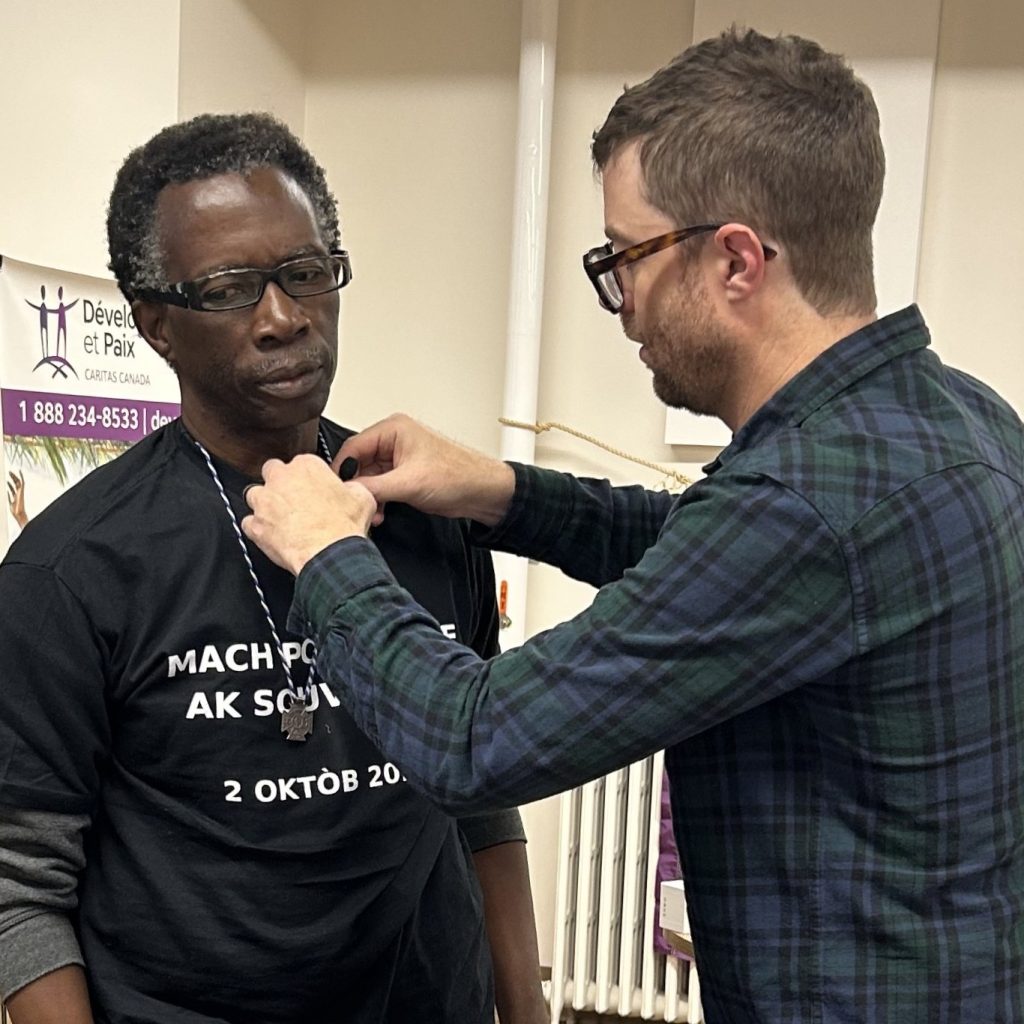
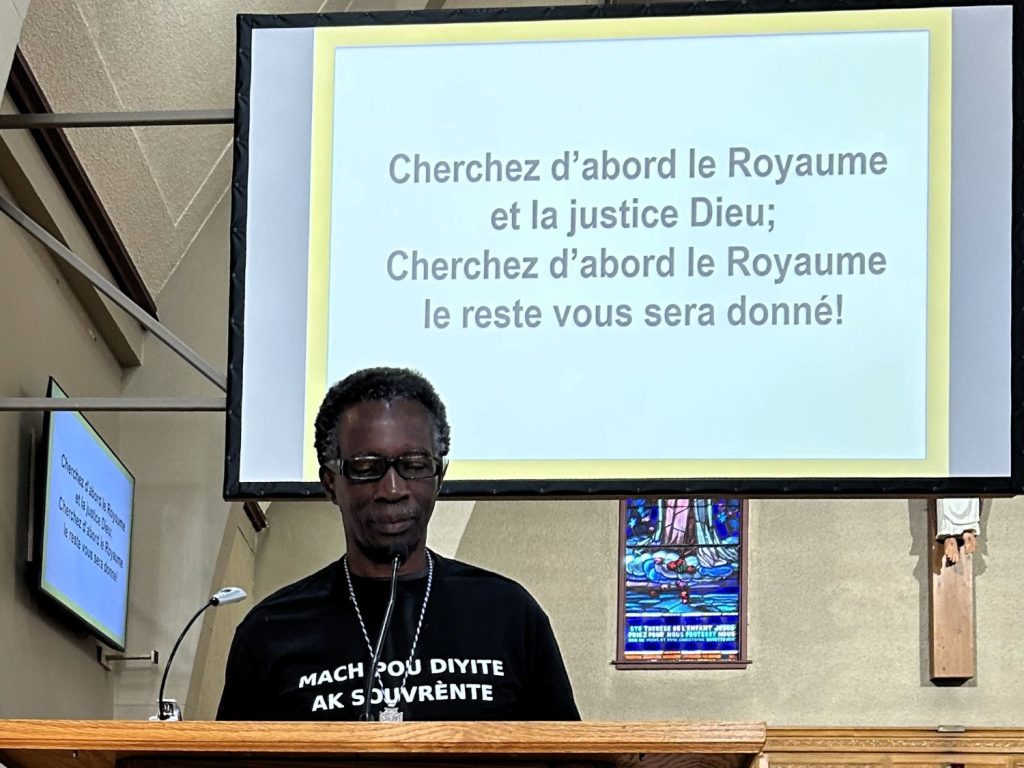
That solidarity knows no borders was the core message of the solidarity visit of Ary Régis, who was in Moncton from October 30 to November 2, 2026. Through several meetings with DPCC members and parish communities in Greater Moncton, he issued a call for peace, environmental protection and greater accountability for the consequences of Canadian economic activities in Haiti and the Dominican Republic.
A solidarity visit that clarified connections
On Saturday, October 31, 25 people gathered in a community hall at the Place de la Cathédrale to meet Regis and hear his testimony. This gathering was opportunity to discuss the close connections between the ecological crisis, social justice and peace, and to gain a better understanding of the realities faced by communities in regions affected by mining.
One of the key messages in Régis’s speech that particularly caught people’s attention was that the climate cannot change on its own. For him, it is not enough simply to observe climate change, lament environmental degradation or hope that the situation will improve by itself. We must tackle the root causes of the crisis. This means transforming our economic systems, reviewing our development models and changing our lifestyles, especially our consumption habits and our relationship with natural resources.
This reflection is in line with the call to ecological conversion issued by Pope Francis in his encyclical, Laudato si’. Caring for our common home requires more than just individual actions. It calls for a transformation of our structures and our collective choices. Justice for the most vulnerable and the protection of creation are inseparable.
Mining and its cross-border consequences
During his solidarity visit, Regis wished to draw the public’s attention to the activities of Canadian mining companies in Haiti and the Dominican Republic.
Mining operations in the Dominican Republic, especially in regions near the border with Haiti, have worrying consequences for the environment and for communities living on both sides of the border. The degradation of ecosystems and the impact on people’s living conditions raise important questions about corporate responsibility, the protection of human rights and respect for the environment.
For the communities concerned, the issues at stake are not abstract. They affect their land, their natural resources, their living conditions and their future. Regis underlined that economic decisions and the overseas activities of Canadian companies are not without consequences for local populations. They must be subject to public scrutiny and vigilance.
Parleying with parishes
On October 31, Regis met with the congregation of Sainte-Thérèse Church in Dieppe. The next day, he delivered the same message to parishioners and members of the local Haitian community after Mass at the University of Moncton’s Notre-Dame-d’Acadie Church.
These moments of sharing gave those present the chance to gain a better understanding of the challenges facing the Haitian and Dominican communities and to reflect on their own commitment.
An opportunity to listen and to learn
During the Montreal leg of his solidarity visit, Régis met members of the diocesan councils of Saint-Jean–Longueuil and Saint-Hyacinthe during a training workshop. The meeting helped members understand the importance of hearing directly from our partners and learn how our commitment here helps to support their work on the ground.
Through testimonies and videos showcasing the work of his organization, Groupe d’action francophone pour l’environnement (GAFE; see website in French), in Haiti, Régis highlighted communities that are mobilizing, organizing and acting to transform their circumstances. Far from being passive reduced to their vulnerability, these are committed people, with whom we are moving forward in a shared quest for justice and dignity. “We may be far apart, but we carry one another in our hearts,” he reminded us.
Régis also led us to reflect on what showing solidarity with our partners means in practical terms. His solidarity visit was an illustration. By giving him the opportunity to meet members, to bear witness to his communities’ realities and to bring their concerns to the public’s attention, DPCC is helping to amplify voices that need to be heard more clearly.
Régis’s testimony highlighted just how interdependent our realities are and how decisions taken in Canada affect the lives and livelihoods of communities far beyond our borders. It raised an important question amongst members: having heard these realities, what action can we take?
This question ties in perfectly with our Is Canada on Track for Justice? campaign, which underscores that looking after Canadians and looking after others interdependent and not opposite objectives. Against a backdrop of declining international solidarity and cuts to official development assistance, this solidarity visit was a reminder that coming together, listening and acting together are as important as supporting initiatives abroad.
A solidarity visit that dispelled prejudices
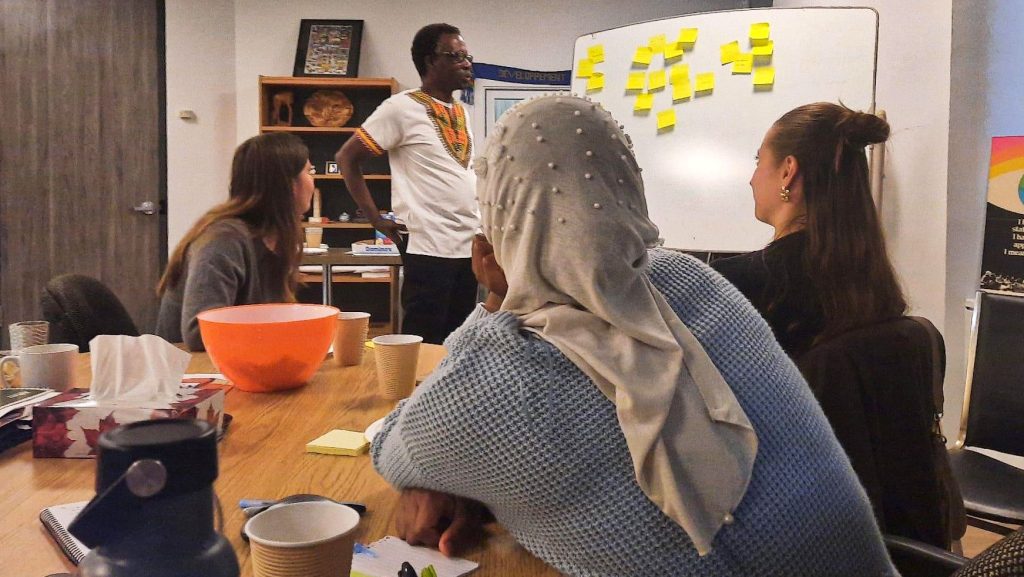
In Montreal, Régis also met a group of young members at DPCC’s headquarters on November 5. The discussion revolved around a question: how are our perceptions about Haiti formed?
Through a participatory activity, youths shared the associations they spontaneously made with the country. These included the earthquake, insecurity, gangs and the humanitarian crisis. These elements became the starting point for examining the images we retain of a country and what they sometimes leave out.
Indeed, beyond these issues, what do we know about local initiatives and the communities’ efforts to improve their living conditions?
Régis provided glimpses of these through his presentation on GAFE’s work. It helped the youths discover the role of creativity, culture and music―all deeply rooted in Haitian identity―as means of expression, communication and mobilization.
The meeting also prompted reflection on the role of young people in social change; how local populations perceive international aid; and the importance of understanding the needs expressed by communities, recognizing their capacity to act, and prioritizing forms of solidarity that respect their autonomy and dignity. These insights underpin the DPCC approaches of working with local partners and recognizing communities as full participants in their own development.
Also read: