
By Kiegan Irish, Advocacy Officer
During a solidarity visit organized as part of our ongoing Is Canada on Track for Justice? campaign, Haitian educationist and activist Ary Régis toured eastern Canada, meeting parliamentarians, civil society representatives, Development and Peace ― Caritas Canada (DPCC) members and youths. This is the first of a two-part account of his two-week trip, which concluded on November 6, 2026.
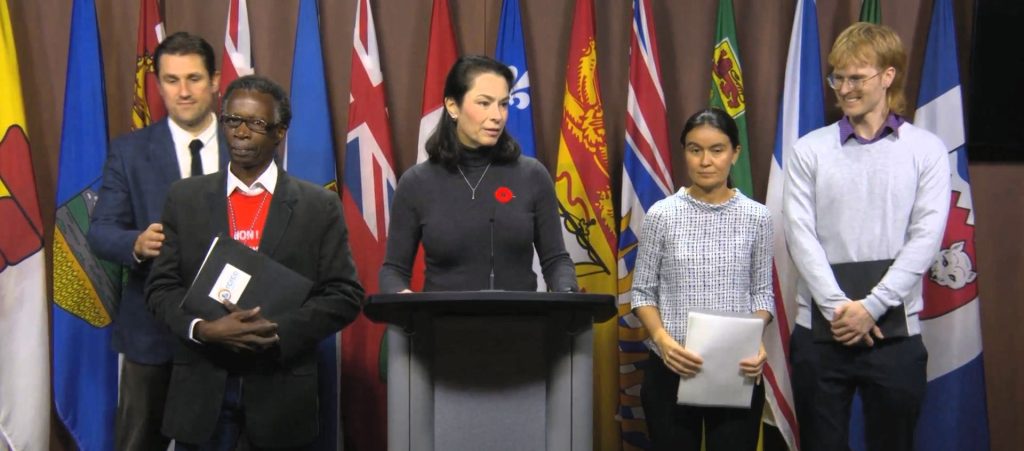
Accompanying Ary Régis on the Ottawa leg of his solidarity visit was an honour. Régis, who has a doctorate in education and e-learning, teaches at the State University of Haiti and is a member of the Groupe d’action francophone pour l’environnement (GAFE; see website in French). GAFE helps communities across Haiti to better understand their rights and to protect the delicate ecology of their island.
Régis met with Canadian civil society organizations and interfaced directly with the Canadian government. It was a real joy to work alongside him and collaborate to amplify GAFE’s message of care for our common home and shared human dignity.
A solidarity visit focussed on Canada’s extractive industry
GAFE works with communities in northern Haiti who are concerned by the actions of Unigold, a Canadian corporation that proposes to build a gold mine in the Dominican Republic, near the Haitian frontier. This mine would carry significant risks for the watershed, rivers and general ecology that are shared across the border.
Communities depend on these water sources for their daily lives, including to irrigate their crops. At an intercommunal meeting organized by GAFE, nine communities in the affected zone voted unanimously to oppose the mine. They have since been working to engage the company, the Haitian government and Canadian diplomats in Haiti. Régis’s visit to Ottawa allowed him to further these outreach efforts by interacting directly with representatives of the Canadian government.
DPCC has been campaigning for corporate accountability for more than a decade for exactly this reason. Our partners in the Global South have long said that one of the most effective solidarity actions we can take in Canada is to constrain Canadian companies from committing abuses against human rights and the environment.
To engage in a joint advocacy effort with Régis to bring concerns directly to Ottawa, our allies in MiningWatch Canada also invited Dominican community leader Leoncia Ramos. She represents Dominican communities for whom an existing mine has already created the very catastrophic realities that their Haitian neighbours fear a proposed mine will bring about.
The five communities and hundreds of families Ramos accompanies have long opposed Pueblo Viejo, Latin America’s largest gold mine, which its Canadian operator, Barrick Gold, is now seeking to expand. These people have suffered contamination of the air, lands and waters, leading to severe health impacts and loss of livelihoods, without any recompense.
A solidarity visit that engaged government and civil society
Our delegation was able to meet a cross-section of representatives from the Canadian government, including parliamentarians, Global Affairs Canada staff responsible for the region and legislators working on the overseas impacts of Canadian companies.
The Hon. Heather MacPherson, MP for Edmonton Strathcona, supported us in hosting a press conference on Parliament Hill on Wednesday, October 28 (watch bilingual video). The conference, attended by journalists accredited to the Canadian Parliamentary Press Gallery, was a sort of follow-up to a hearing of the Inter-American Commission on Human Rights held two days earlier in Panama. At that hearing, representatives from six different communities testified that they have faced violence, environmental degradation and displacement because of the actions of Canadian extractive companies.
Over the course of several meetings, it was our privilege to sensitize members of the Canadian government to the realities of people living with the global impacts of Canadian political choices and economic systems. Conversations around mining legislation and the demand for minerals can seem abstract. But the abstraction is stripped away when we are faced with real people like Régis and Ramos, who share real stories about the impacts of these decisions have on their lives and the ecology that they are part of.
A solidarity visit that raised tough questions
Is it good for the Canadian economy if we extract more gold from the earth? But even if it is, are we willing to live with the consequences? Are we willing to contaminate rivers people drink from with cyanide? Are we willing to condemn children in affected communities to die of unknown cancers? Are we willing to trade away the integrity of the land and its capacity to produce healthy fruits and vegetables?
These were the questions that Régis and Ramos left us with.
Régis also shared his message with DPCC members during a webinar on October 29, the recoding of which can be watched below.
Later that evening, Régis and Ramos interacted with young people at an event organized, promoted and hosted by students at the University of Ottawa.
Events like these are a critical part of any solidarity visit. They provide the space to hear each others’ stories and dialogue face-to-face. One could clearly see on the students’ faces how moving it was for them to hear of the struggles of families in the Dominican Republic whose lands have been despoiled and of how important it is for communities in Haiti to be able to root their independence in agriculture and their relationship to ecology. Giving such a human face to abstract and distant concerns awakens an urge to act and to set right the injustices that our sisters and brothers face.
Are we On Track for Justice?
Canada is turning inward, centering its own problems and fears and building a policy landscape that reflects that prioritization. Our government is investing more in military spending whilst slashing international aid and development funding and defunding most non-trade-related diplomatic efforts. These political decisions have real consequences for those who most need international aid and those seeking diplomatic solutions to conflict.
But there is another level to this policy shift that reflects on Canadians themselves. At DPCC, we believe in international solidarity partly because it helps us to understand our world and to pierce the veil of big abstractions like global climate change and economic forces by placing the human beings, relationships and stories behind them at the centre.
This fuller, richer picture of the world and this deepening of relationship are what we mean by solidarity. And they are what we risk losing should Canada turn away from leadership in the sphere of international assistance.
Also read: