
By Mary Durran, Latin America Programs Officer
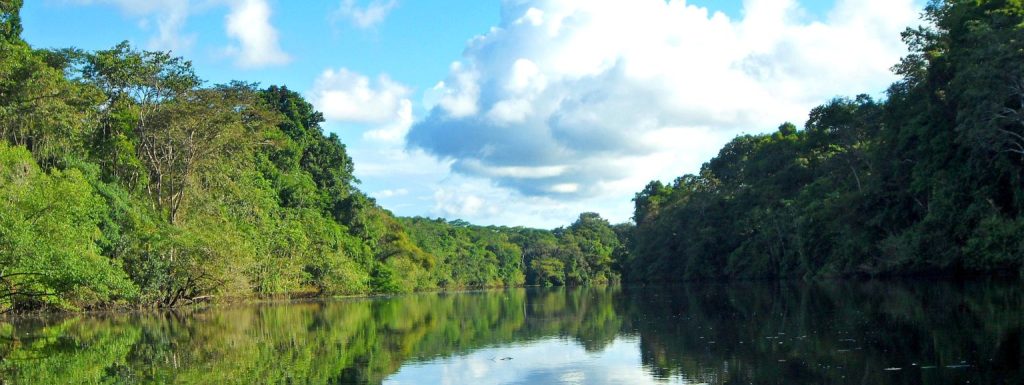
Four days before Pope Leo XIV visited Pucallpa, Peru, Marcelina Algulo Chota left home at dawn. From her village, Miraflores, in Alto Nanay district, in the department of Loreto, she travelled two days on a motorboat down the winding River Marañón. Then, she took a government humanitarian flight to Pucallpa, the city whose name means “red earth,” to attend the Holy Father’s November 15 meeting Indigenous peoples and missionaries.
Why it’s “not easy” in Peru
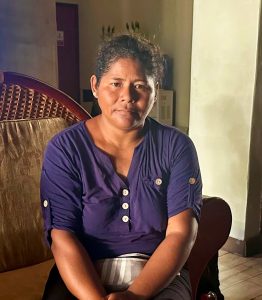
“Being an environmental defender is not easy,” said Marcelina, an Indigenous Ikitu woman whose family has been torn apart by the illegal gold mining that ravages the Alto Nanay region. Those responsible are mostly foreigners from other South American countries, but some locals cooperate with them, too.
“Kids of 12 and 13 work with the illegal miners; some young girls have turned to prostitution; and there is a HIV emergency there,” added Marcelina.
She has been trained in human rights by the Vicariate of Iquitos, which is supported by the Centro Amazonico de Antropologia en Aplicacion Practica (CAAAP, Amazonian Centre for Applied Anthropology; see website in Spanish), a partner of Development and Peace ― Caritas Canada. Hers is a challenging and dangerous occupation, especially in Peru.
“When we speak out against the illegal gold mining in the region, it damages the prospectors and slows down their attempts to take over the whole forest,” Marcelina said, explaining why people like her face so much violence (see Amazon Frontlines report).
The cry for justice in Peru
Since Pope Francis visited in 2018, 37 environmental defenders have been murdered in the Peruvian Amazon. About them, Pope Leo XIV said in Pucallpa, “The blood of these brothers cries out to God and demands justice.”
Marcelina’s own family has come a hair’s breadth from such a fate. In October 2025, thugs attempted to kidnap her 17-year-old son, Victor Manuel Chichipe Angulo, from the family home. He was saved when the vigilant community gathered around and forced the attackers to leave. Her other son, Jose David, now six, was traumatized by the incident. Both boys have since left to join their father in Iquitos, where he has been living since over two years.
Marcelina chose to stay on with her mother, determined to protect the forest from the dredgers that, in the absence of the state, are gradually destroying the forest and polluting the river on which the people depend for food. “We patrol regularly to try to protect the environment in zones where the illegal miners are trying to move in,” she reported. To continue this surveillance, however, her group of local defenders needs funds for fuel for their boats.
The age-old greed for gold
Human rights organizations and civil society watchdogs have denounced the corrupt links of complicity between certain Peruvian politicians and illegal mining. The illegally mined gold is laundered in Amazonian cities, sent to Lima and then exported on to international hubs in the USA, Switzerland, the UAE and India. Accounting for 44 per cent of South America’s illegal gold trade, this venture is very lucrative; gold prices reached US$3,763 an ounce this week.
The harms caused by this trade “are not isolated accidents, but the consequences of the irresponsible exploitation of natural resources, which undermines the very existence of communities,” the pope lamented. “The cry of the earth and the cry of the poor are inseparable, exposing patterns of exploitation and economic activity that threaten the balance of creation,” he said.
The Holy Father also addressed the situation women and girls in the context of illegal mining, saying, “We are deeply concerned for the vulnerability of so many women, girls and adolescents, and by the suffering of those who experience violence and sexual abuse. Such abuse leaves deep wounds, often compounded by complicity and impunity.” He continued, “In this situation, the Gospel calls us all the more urgently to personal and communal conversion, offering renewed hope for healing, consolation and reparation.”